
Most of us think of handwriting as something practical. We use it to take notes, sign forms, write lists or fill journals. Yet give the same alphabet to thirty children in one classroom and, over time, their writing begins to look very different.
The size changes. The spacing changes. Pressure, slant, rhythm, margins and even the way individual letters are formed begin to develop their own character.
That individuality is what makes handwriting analysis interesting. A practitioner studies the page as a pattern of movement and expression, then looks more closely at individual letters, strokes, loops and the signature. The intention is to explore how these patterns may connect with the way a person thinks, reacts, relates, works and expresses emotion.
For a beginner, the most important thing to understand is that handwriting has both a larger pattern and hundreds of smaller details. A meaningful reading looks at both.
What Is Happening When You Write?
Writing begins before the pen touches the paper.
Your brain retrieves language, organises words, plans movement, controls the hand and fingers, uses visual feedback and places everything in space. Researchers describe handwriting as a complex cognitive and motor activity.
This also helps explain why writing becomes so individual. A large study involving 1,500 people found that combinations of features such as slant, line spacing and character shapes could distinguish writers with a high degree of confidence. Forensic document experts use this individuality when they compare authorship. Personality interpretation asks a different question, so these two fields should be understood separately.
Graphology looks at the expressive patterns within writing and interprets them through a behavioural framework. The reading becomes much richer when the practitioner studies the overall page and the smaller details together.
How Does Handwriting Analysis Work at the Macro Level?
Macro analysis begins with the page as a whole.
Before reading a single word, you can notice how the writing occupies space. A practitioner may observe size, slant, pressure, rhythm, line direction, margins, spacing, connectivity and the overall movement of the script.
Imagine two pages. One contains small, tightly packed writing with narrow margins and strong pressure. The other has larger letters, more open spacing and lighter movement. Even before studying individual alphabets, the visual experience is completely different.
The important part is the combination.
Strong pressure does not carry one fixed meaning. Its interpretation changes when the writing also appears rushed, compressed, slow, steady, angular or flowing.
This is why statements such as “large handwriting means confidence” or “left slant means emotional distance” oversimplify the subject. One characteristic can contribute to an interpretation. It cannot explain the entire person.
Why Do Individual Alphabets Matter in Graphology?
This is where micro analysis begins.
Micro analysis looks closely at how you form individual alphabets, loops and strokes. It may study how you cross a t, dot an i, close an o, form an a, or create the lower zones of letters such as g, y and j.
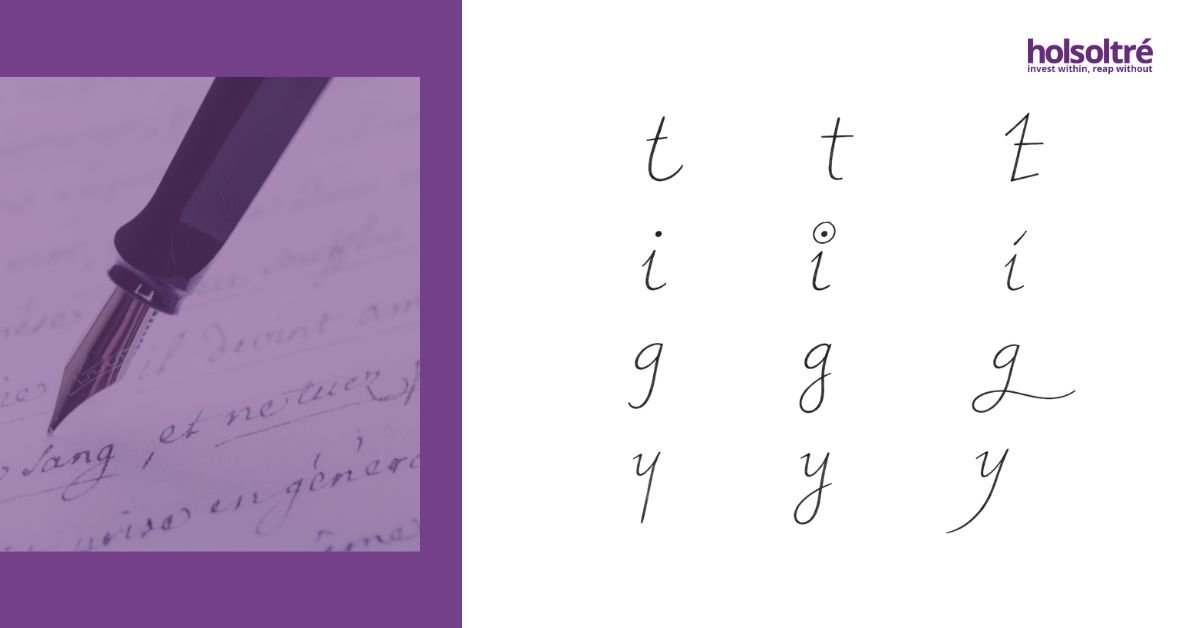
Take a lowercase t. Its stem can be tall or short. The crossbar may sit high, low or somewhere in the middle. It can extend far beyond the stem, stop close to it, rise upwards or cut straight across.
Traditional systems attach different interpretations to these variations, especially when the same formation repeats and other traits point towards a similar pattern.
The same applies to loops, retracing, angularity, width, pressure and unusual letter formations. Capitals create another layer. So does the signature.
This is where good interpretation becomes more complex than reading one alphabet at a time. One letter may offer a clue. Repetition makes the clue more relevant. The macro traits, micro traits, signature and context together create the fuller picture.
What Can Your Handwriting Reveal About Your Patterns?
This is usually the part that surprises people.
Traditional handwriting interpretation reaches far beyond whether someone appears shy, social or confident.
A practitioner may explore mental patterns such as concentration, decision making, overthinking, adaptability, imagination, procrastination and how someone responds when several things demand their attention.
The emotional layer can bring up very different questions. How freely do you express what you feel? Do you hold anger until it builds? Do you react quickly and calm down quickly? Does criticism affect you deeply? Do you remain controlled even when something hurts?
These observations can lead into themes around sensitivity, frustration, emotional restraint, trust, fear, resilience and the need for reassurance.
Then there are relationships.
Traditional systems may explore closeness, boundaries, attachment, dependency, personal space and what happens when intimacy begins to feel vulnerable. Someone may want deep emotional connection and still withdraw during conflict. Another person may appear very independent while carrying a strong fear of abandonment.
Some schools also interpret lower zone formations, loops, rhythm, spacing and pressure in relation to sensuality, physical expression and comfort with sexual intimacy.
Money can reveal another side of behaviour. A practitioner may explore themes around security, spending, saving, risk, impulsivity and the emotional meaning a person gives to money.
Work patterns can add yet another layer: leadership, initiative, persistence, response to authority, independence, teamwork, ability to handle pressure and the need for structure.
The current professional framework at holsoltre includes emotional, behavioural, relationship, financial and professional patterns within its consultations.
What makes this interesting is the connection between these areas.
Someone who fears criticism may also hesitate to ask for money, avoid visibility at work and suppress their needs in relationships. A person with a strong need for control may carry that same pattern into decision making, finances and intimacy.
One underlying tendency can show up in several parts of life.
That gives you much more to explore than a long list of disconnected personality traits.
Can Handwriting Reveal Subconscious Fears?
It can give a practitioner another route into patterns the writer may not consciously notice.
Imagine someone saying, “I know I need to speak up, but the moment conflict starts, I go silent.”
Their writing may contain several features which, within the practitioner’s framework, suggest restraint, hesitation, sensitivity to criticism or a high degree of control. That becomes a starting point for exploring what actually happens in the person’s life.
The handwriting does not explain every cause. Childhood experiences, relationships, culture, health and current circumstances all shape behaviour.
This is also where awareness needs to be understood properly.
Recognising that you suppress anger can be powerful. It does not automatically teach you how to express anger safely. Seeing a pattern of over adjustment does not immediately create stronger boundaries.
Awareness gives you a clearer place to begin.
What Does Your Signature Add to the Reading?
Many people write their signature very differently from their normal handwriting.
A signature can be larger, smaller, more decorative, more compressed or much harder to read. Some people underline their name. Others enlarge the initials or reduce the whole signature into a quick mark.
Traditional interpretation looks at the relationship between the signature and the body text.
A strong difference between them may open questions around self presentation, identity, confidence or the way someone wants others to see them.
Again, the practitioner reads the signature in context. A dramatic signature does not create a personality verdict by itself.
What If Your Handwriting Keeps Changing?
This is one of the most common questions people ask about handwriting analysis, and it is a valid one.
Your handwriting is bound to change because writing is a brain directed motor activity. Your brain plans the movement, while your hand and fingers carry it onto the page. In that sense, handwriting can be understood almost like a form of micro body language. How you are feeling, how quickly you are writing, your posture, the pen you are using, the surface, fatigue, mood, age and physical state can all influence the way that movement appears on paper.
Something you write calmly at your desk may therefore look different from a sentence scribbled during a stressful phone call. If you are anxious, angry, exhausted or rushing, those conditions can influence the writing too. Interestingly, that variation itself can sometimes be useful because it shows how your writing changes when you are functioning under a particular state.
At the same time, research in forensic handwriting has found both variation within the same writer and recurring individual characteristics. So, while handwriting changes, many underlying features can remain recognisable.
This is why sample collection matters. Think of it somewhat like a blood test. The conditions under which a sample is taken can influence what you see, which is why certain tests require fasting or other preparation. Similarly, a graphologist needs enough natural writing, produced under appropriate conditions, to understand your broader writing pattern rather than analysing one rushed sentence or an unusually stressful moment.
A proper sample allows repeated traits to emerge. Comparing journal entries, work notes or writing from different emotional states can then add another layer and help reveal what remains consistent and what changes with the situation
How Should a Beginner Approach a Handwriting Reading?
Go into it with curiosity.
A useful consultation should help you connect patterns that may have previously looked unrelated.
Perhaps fear of criticism appears alongside perfectionism and difficulty asking for what you need. Perhaps independence sits beside fear of abandonment. Perhaps your relationship with money, boundaries and visibility all seem to carry the same underlying need for safety.
Those connections give you something meaningful to observe after the reading.
Handwriting analysis becomes most useful when it leads to better questions:
What is the root cause between my relationship fall outs? Where does this pattern show up in my life? When does it become stronger? What triggers it? How does it affect my choices? Which parts of it support me? Which parts have started limiting me?
The page gives you clues. Your lived experience gives those clues context.
A thoughtful reading should leave you with greater self understanding and a clearer idea of what you want to explore next. Want to see what your handwriting may reveal about your emotional, behavioural and relationship patterns? Book your personalised handwriting analysis session.
Holsoltre services are intended for spiritual exploration, self-reflection and personal development. They do not diagnose or treat medical or mental-health conditions and do not replace qualified medical, psychological, legal or financial support.
